Controls & electrical
Sauna heater electrical checklist for Ontario: what to hand your electrician
Wiring a sauna heater in Ontario? Who can do the work, the ESA notification, breaker and wire from the manual, panel capacity and where the contactor goes.
On this page5 sections
An electric sauna heater is permanently wired to its own 240 V circuit, and in Ontario that work is regulated. Use this checklist to get the right details to your electrician before you order, so the heater, control and wiring all line up on installation day.
Who can do the work in Ontario
- Hiring someone? ESA says that if you hire anyone to do electrical work in your home, by law it must be a Licensed Electrical Contractor (LEC). Check the licence with ESA’s contractor locator. Your LEC files the notification and books the inspection.
- Doing it yourself? ESA lets homeowners do electrical work in their own home, but you must file a notification (a permit) with ESA before you start and have the work reviewed before you cover it. Friends, family members and neighbours can’t do it for you. ESA says fees for many small residential projects can be under $100.
- Check the heater maker’s rules too. Harvia, HUUM and Homecraft all say their heaters must be connected by a qualified or licensed electrician. Homecraft’s manual says a connection by a non-certified person voids the warranty.
When the work passes, ESA issues a Certificate of Acceptance. ESA calls it important for insurance and resale. Keep it with your invoice for any warranty claim.
Outside Ontario, your province’s electrical safety authority sets its own permit and inspection process, so check its rules before the work starts.
The checklist
1. The heater’s spec sheet and manual
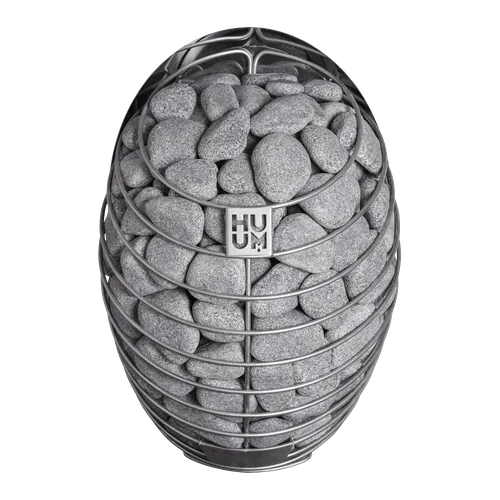
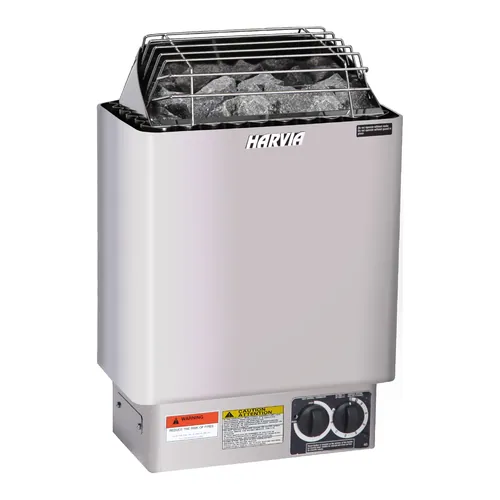
Give your electrician the model, kW, voltage, phase and amps, plus the breaker size and minimum wire gauge from the manual’s table. Don’t size from amps alone. For example, HUUM lists a 50 A breaker and 8 AWG minimum wire for the DROP 9 kW, Homecraft lists a 50 A breaker for the Revive 9 kW, and Harvia lists a 10 AWG supply cable for the KIP 6 kW at 240 V.
2. A dedicated circuit and double-pole breaker
HUUM’s control manual calls for a dedicated circuit, and Harvia’s KIP manual calls for a standard 2-pole breaker. Our advice: label the breaker clearly so anyone can find it.
3. Wire rated for the heat
Harvia requires copper wire rated 90 °C (194 °F) for all wiring on sauna walls and ceilings, and says not to use PVC-insulated cable to connect the heater. HUUM requires a power cable that meets the CSA 49 requirements it lists for Canada, with crimped ends. Homecraft’s tables call for 90 °C copper wire.
4. GFCI: follow the manual
Harvia’s KIP manual says to use a standard 2-pole breaker, not a GFCI. HUUM recommends connecting without a GFCI breaker. Homecraft says a heater on its own circuit doesn’t need one and that GFCI breakers can nuisance-trip. Your electrician applies the Ontario Electrical Safety Code, now the 2024 edition in effect since May 1, 2025.
5. Panel capacity
At 240 V, amps = watts ÷ 240: 6 kW draws 25 A, 8 kW draws 33.3 A, 9 kW draws 37.5 A and 10.5 kW draws 43.8 A. Ask your electrician to confirm your panel has the capacity and a free double-pole space. If it doesn’t, a subpanel or service upgrade may be part of the job.
6. Where the control, sensor and contactor go
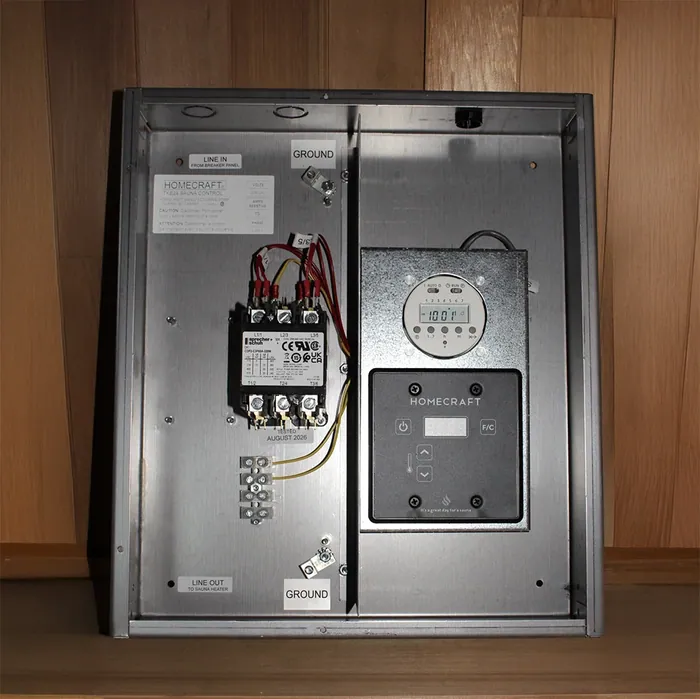
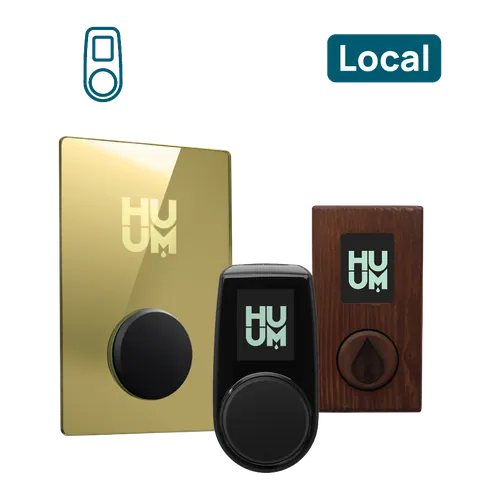
The control electronics always sit outside the hot room. Temperature limits differ by brand: Harvia wants its power unit in a dry place above 0 °C, HUUM rates its UKU main module to −40 °C in a weatherproof housing, and Homecraft sells an outdoor relay box. Distance matters too. Harvia and HUUM both limit the sensor cable to 10 m (about 33 ft), and HUUM limits its control panel cable to 20 m (65 ft). Our controls guide covers the options.
7. No outlets in the sauna room
Harvia says receptacles and plugs aren’t permitted in the sauna room, and Homecraft says not to install any. Use lighting made for sauna use, placed where the heater manual allows.
8. The outdoor run
For a backyard sauna, the feed runs from the house panel or a subpanel, underground or overhead, and it needs to be covered by an ESA notification too. Before anyone digs a trench, request locates through Ontario One Call, which applies to every job, big or small. Use outdoor-rated cable and watertight fittings; Homecraft’s outdoor box instructions mention TECK90 or equivalent.
9. Approved equipment and working safety devices
ESA requires electrical products used or sold in Ontario to carry an accredited certification mark, such as CSA, cUL or cETL. Check the label on the heater and control. Never bypass the high-limit switch or thermostat. In a 2019 safety notice on sauna fires, mostly in commercial facilities, ESA and Ontario’s Fire Marshal pointed to tampered or unapproved safety parts, combustibles left in the sauna and heaters installed too close to combustible materials.
10. 240 V or 208 V?
Most houses have 240 V single-phase power. 208 V three-phase heaters are for commercial buildings. Check before you order.
Handover sheet for your electrician
| Item | Your details |
|---|---|
| Heater brand, model and kW | |
| Voltage and phase | |
| Amps (watts ÷ volts) | |
| Breaker and minimum wire, with manual page | |
| Control model and power unit or relay box | |
| Where the power unit or relay box will mount | |
| Distance from panel to sauna; indoor or outdoor run | |
| Panel size and free double-pole spaces | |
| Wi-Fi needed at the sauna? | |
| Who files the ESA notification |
Next steps
- Choose the size first with our heater size guide or the Heater Finder.
- Browse electric sauna heaters and matching controls.
- Ask us for the manual of the model you’re considering, so your electrician can check it before you order. You pay nothing until you approve a written invoice.
Shop the guide
Products and tools that go with this guide. Prices in CAD, before tax.
Common questions
Do I need an electrician to install a sauna heater in Ontario?
If you hire anyone to do the wiring, Ontario law requires a Licensed Electrical Contractor. Homeowners may wire their own home if they file a notification with ESA first, but Harvia, HUUM and Homecraft all say their heaters must be connected by a qualified or licensed electrician, and Homecraft says a connection by a non-certified person voids its warranty.
What size breaker does a sauna heater need?
Use the table in the manual for your exact model. For example, HUUM lists a 50 A breaker and 8 AWG minimum wire for its DROP 9 kW, and Homecraft lists a 50 A breaker for its Revive 9 kW. Your electrician confirms the size under the Ontario Electrical Safety Code.
Should a sauna heater be on a GFCI breaker?
Follow the manual. Harvia's KIP manual says to use a standard 2-pole breaker and not a GFCI, HUUM recommends connecting without a GFCI breaker, and Homecraft notes that GFCI breakers can nuisance-trip with sauna heaters. Your electrician applies the code on site.
What is an ESA Certificate of Acceptance?
It's the document ESA issues when inspected electrical work passes. ESA describes it as important for insurance and resale. Ask your contractor for a copy, and keep it with your heater invoice.
Sources
Manufacturer documents and official pages we used. Check the manual for your exact model before you install.
- ESA, “DIY electrical work” esasafe.com
- ESA, “What you need to know” (Licensed Electrical Contractors, Certificate of Acceptance) esasafe.com
- ESA, contractor locator licensing.esasafe.com
- ESA, Ontario Electrical Safety Code esasafe.com
- ESA, recognized certification marks esasafe.com
- ESA and Office of the Fire Marshal and Emergency Management, Flash 19-32-FL, electric sauna safety (2019) esasafe.com
- Ontario One Call ontarioonecall.ca
- Harvia, KIP instructions for installation and use pim.harvia.com
- Harvia, KIP60B 6 kW 240 V specifications harvia.com
- Harvia, Fenix and Xenio control unit instructions pim.harvia.com
- HUUM, DROP installation and operation manual (US) huumsauna.com
- HUUM, UKU Wi-Fi/Local user manual (US) huumsauna.com
- Homecraft, touchpad and contactor installation manual homecraftsaunas.com
- Homecraft, general sauna instructions (GFI breakers) homecraftsaunas.com
- Homecraft, Revive sauna heater specifications homecraftsaunas.com
-
Controls & electrical
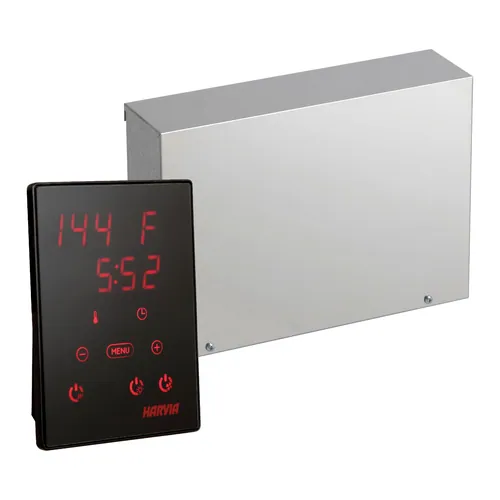
Sauna controls and contactor boxes, explained
Built-in or external control, and do you need a contactor box? How Harvia, HUUM and Homecraft controls pair with heaters, and where they go outdoors.
-
Heaters
What size sauna heater do I need?
Find the right sauna heater size in kW: measure the room, add volume for glass and stone using each maker's rule, then check the amps at 240 V.
-
Outdoor saunas
Outdoor sauna site prep: base, delivery access and permits
Planning a backyard sauna? Check permits and zoning, choose the spot, build a level base, and plan delivery access and power, with Ontario and Toronto rules as worked examples.
Get the heater, control and box right the first time
Tell us your heater and where the box will go. We check every part against the manufacturer’s documents before we invoice you.